
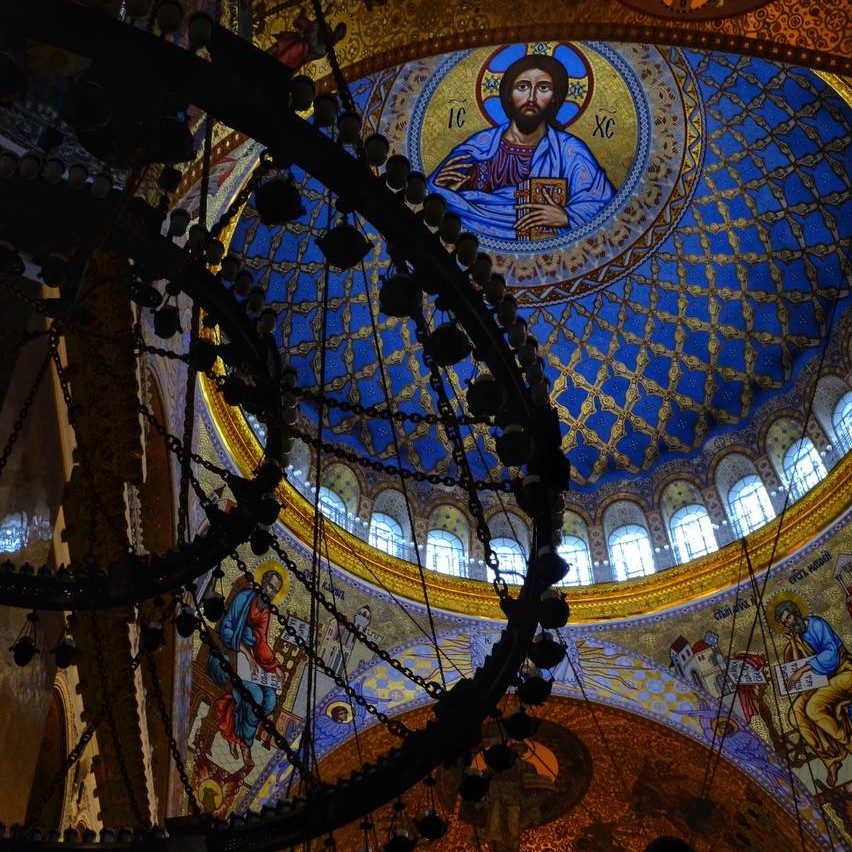
Bulbous onion-domes top the Corinthian columns, and Baroque stucco architraves light up the drowsy city towards the end of daylight. Inside, it is dark, but gilt-edged. Puffs of incensed air linger reverently amongst the faded murals whose shades merge in a sfumato. It was Friday on a late December evening in, I believe, 2015. I was visiting St Petersburg as a tourist, and this was probably the first time I had ever attended the Divine Liturgy at an Orthodox church. The clock struck five just as I approached the Kazan Cathedral. As well as insatiably curious, I have always been fascinated by spiritual places – so I had to go and have a look.
Enigmatic ladies with the look of salvation and cowled in head-scarves light candles and form orderly queues to kiss ancient icons that portray a multitude of saints. They move like chess pieces between relics lit by lamps and candles, kissing the glass and then quickly rubbing away the mark. Their azure-coloured eyes never meet mine. I feel invisible amongst the funereal expressions. Soft, fervent whispers echo around the vaulted, frescoed naves. Church Slavonic – a language of soft sibilants and palatal fricatives – is made for whispering and chanting. The zig-zagging sentences and repetitive poetics of the language are just beyond the reach of the standing Congregation. I stand, letting myself float in the harmonic consonance of the language. I want the sounds to be impressed on my brain.
Vigil lamps hang from brass chains. Mystical and heavenly, the First Antiphon is chanted from somewhere in a cappella harmony; fragments of a mystical vision, a bridge to the beyond. The purity of the human voice, the most perfect instrument of praise, with no musical accompaniment to trivialise things. No guitars or gospel here; just continuity, authenticity and tradition. Unmodernised, its appeal is as transcendental as the faith it is show-casing. Rooted in past traditions and with the immediate symbolism of the relics, it transcends time and the world.
Surely weary, they have been standing for over an hour now. I stand with the upright poise of the spiritual man, lost in borrowed thoughts, indulged in the inner lyrical grace of the words being issued forth. Bearded men in heavy cassocks emerge from hidden doorways behind the gilded iconostasis, swinging chinking censers. Then they disappear dragging their shadows behind them, only to reappear moments later from another concealed door, grasping a heavy, ancient tome with marbled fore-edges. The booming basso profondo of the priest’s voice resonates from the ambon, saturating the church with an eschatological spirit.
At the end of the service, I leave the church – crippling contractions in the lower back, cramp in my right foot –, but already aware that I have witnessed a kind of reverence and holiness I have never found elsewhere. Even if I did not understand a word of the Liturgy or know anything about Orthodoxy, my first impression was that there was in this place of worship an appeal to the inner-self, the private inner sanctuary of peace. In the days that followed, I walked the streets of St Petersburg beneath cupolas that glittered in the reddish light of the low sun. Then the sky disappeared, and the cold imprisoned my erring thoughts about what I had witnessed. Occasionally, I would hop into a church to escape the freezing temperatures and once again return to that other world of holiness whose appeal had already etched itself onto my soul. The miracle of time having stood still. I felt like I was being taken back to an ancient past but at the same time being shown a new future. A single moment of revelation and our lives can be suddenly transformed.
After five days in the city, I returned to Oxford, but I couldn’t forget the glimpses of the transcendental that I had experienced. The following year, I went to Romania and once again found myself going from church to church drawn by the lure of the Orthodoxy with its continuity, steadfastness and philosophical magnetism. Anyone who didn’t know me might fairly assume that I was a devout person brought up on the precepts of the Lord, but the truth was remorsefully other. I had not had a theistic upbringing. Never tempted by atheism, I subscribed to Pascal’s wager. Atheism seemed to me like a meaningless, mono-dimensional path. I think I wanted to be a Christian (I mean not just nominally), but felt like this path was just too difficult in the modern, hedonistic world that we live in. Long before I became an anthropologist, I liked to visit churches because, in part, I felt like it was a window onto the local culture. Then, something significant happened. I was offered a post as an Associate Professor at one of the universities in Moscow. Fate had intervened. It was only after I became an Orthodox Christian some years later that I realised it was in fact God who brought me to Russia; that I was meant to be here and that I was here for a reason.
When I first came to Moscow, I would visit quite frequently a whole host of churches and monasteries dotted around the city. Billed as the third Rome, there are hundreds of Orthodox churches in Moscow. Initially, my interest was perhaps more ethnographic than personal. A linguistic anthropologist, I was intrigued by the liturgical language (Church Slavonic) and how parishioners relate to this language that is by many only partially understood. Every Easter and Christmas, I would attend the Divine Liturgy at St Nicholas the Benefactor (Park Kultury, Moscow) which dates from the seventeenth century. This was an unforgettable experience; a phenomenological awakening that left me suspended somewhere between heaven and earth.
In these ancient Orthodox churches, I was looking for the romance of Holy Russia, I suppose, but it was much more than that. I felt closer to the sacred in these places where worshippers had been coming for hundreds of years because there is a greater sense of otherness to be found there. I felt a spirit there that you can’t define, but it draws you back time and time again. As an exotiste (as the French might describe me), I have no qualms in admitting that otherness has always had great appeal for me. That is one of the reasons why I became an anthropologist. An English-language Orthodox service held in a brand-new church would never have the same appeal. Familiarity holds no sacred allure for me.
Over time, it became apparent that this could never be for me merely an academic exercise. I didn’t want to be just rational and objective about what I was experiencing. After a great deal of reflection, I was beginning to think that I wanted to be an integral part of all this worship. My heart was yearning for the sacred, for Meister Eckhart’s “deity within”; there was some kind of emptiness that needed to be filled. I could no longer be just an observer.
I met Father Andrei in August of 2023. We sat on the bench in the garden at Saint Antipas Church in the center of Moscow, a stone’s throw away from the Kremlin. A friend had put me in touch with Father Andrei because I mentioned to her that I was thinking about becoming an Orthodox Christian. “Oh you must meet Father Andrei”, she said excitedly. Father Andrei’s first question was “How old are you?”, speculating perhaps on what would make someone seek God at this point in his life. That was followed by “Why do you want to become Orthodox?” (I was christened in the Church of England, but only really became interested in religion once I discovered Orthodoxy). Father Andrei’s question was an obvious one, but I didn’t have a set answer in my mind for I had not yet really grasped the idea that I might actually ‘convert’ (I don’t like the word ‘convert’ because of the evangelical undertones which do not relate to my experience at all). My thinking on the subject was still rather uncertain and speculative. “I am looking for the transcendental and I think I can find it here”, I responded without giving the question too much thought. With retrospect, my answer to his question might have seemed slightly pompous, but it was absolutely honest. I wanted to deepen those occasional intimations I had had of a world beyond. For me, the appeal of Russian Orthodox churches is they offer a glimpse of transcendence in a world where transcendence and the subliminal have been almost expunged. I believed a transcendental pathway could show me something beyond the material defined by the limitations of the subject-object world. My interest in Orthodoxy had become more than just ethnographic.
At the end of our meeting on that warm, summer afternoon Father Andrei gave me his phone number and asked me to get in touch with him. Unfortunately, we both had left our phones at home, so he wrote the number down on a piece of paper. When I got home, I found his name and profile photo in my What’s App list even though I had never met him before. I told Olga who had put me in touch with Father Andrei this story: “Oh,” she said, “stick with him. He is your batoushka” (‘spiritual guide’). She did not seem surprised by this turn of events. I might point out that at times I didn’t feel I was entirely in control of the “conversion” process. It was as if a wind were blowing behind me. I felt strongly that I had been shown a path and that I should follow it. Saint Catherine of Genoa once said “When God wishes to penetrate a soul, he first abandons it completely.” I began to wonder if this is what had happened to me, and whether I was experiencing that Meister Eckhartian “God is clearing his throat” moment.
I then spent six months reading the gospels, the psalms, the Way of a Pilgrim, some of the early Church Fathers as well as the works of Schmemann, Alexander Men and even Seraphim Rose. I kept pondering whether this was the right path for me. There were certainly many doubts. And what made me most anxious of all was the life confession that I would have to give in Russian. Where would I start with that, how would I structure it? Father John Krestiankin’s book The Experience of Preparing a Confession was a great help in this regard.
* * *
Stephen Pax Leonard is an author, linguist, and traveller. He lives in Moscow. Books: Noble Sentiments for an Exile: And Other Writings (Wipf& Stock, 2024), Annals of Solitude: A Year in a Hut in the Arctic (Wipf& Stock, 2022), The Ideology of Failure (2018). He regularly contributes to Country Squire Magazine. More at: https://stephenpaxleonard.com/
Bild © Stephen Pax Leonard. Alle Rechte vorbehalten.