
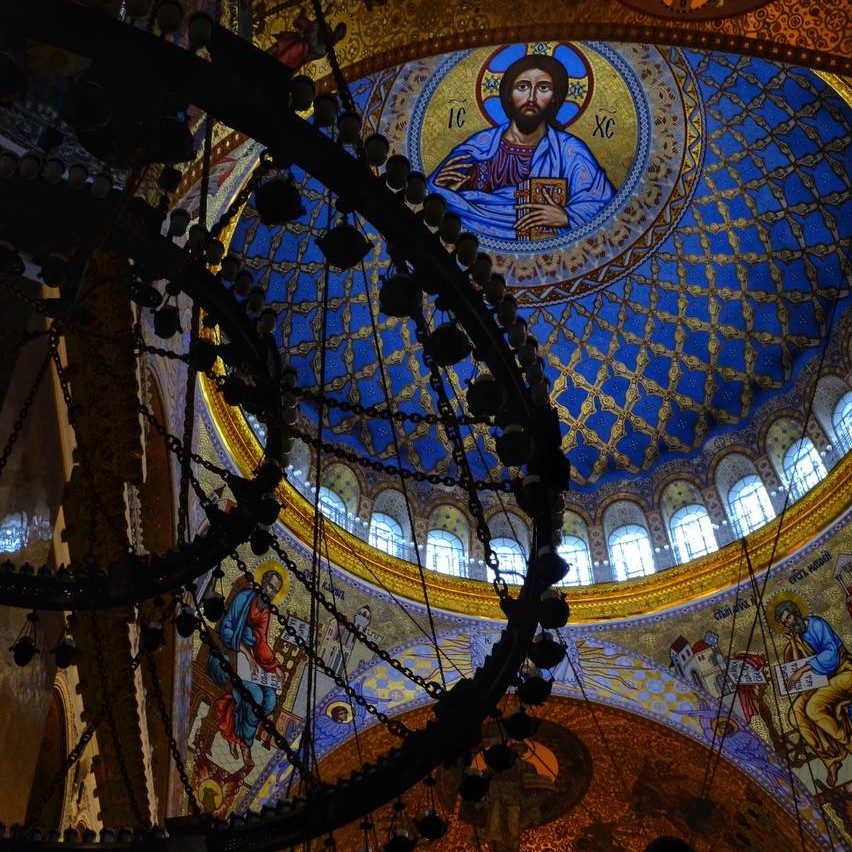
I close the door to the church and shut out the vexations of the ordinary world. A few worshippers skulk in the ante-chapel. Confessants queue, asking to have their transgressions wiped away. Old women bent over in the shape of question marks whisper supplications. Their pious manner is propaganda for sainthood. Dripping candle wax: God is listening to the accounts of the mortals. The original grace lost, they can only offer up supplicatory words as collateral, but God knows they are not intrinsically bad. God is love; love is kind; God is kind: the chain of syllogisms goes on and on. And the confessants’ words can change everything for they might result in spiritual renewal. Soon, they will sup from the sacramental spoon and a new chapter of salvation will begin.
It is 08:00 am on a Wednesday morning (20th March 2024). At the normal matins, there might be eight people or so. But today, there are 20 brought together by a subjective experience of an invisible presence. I join the congregation and stand in my normal spot. My sweaty hands grip the five-page life confession written in Russian that I have been labouring over these past weeks. I am a little tense. I am not sure that Father Andrei will understand my confession or indeed what the ceremony will comprise.
After about twenty minutes of crossing myself, Father Andrei appears from the curtained door to the altar and directs me to the ante-chapel. I assume that the chrismation will take place there, but am mistaken. He leads me downstairs to the crypt, kisses the icon of Saint Matrona and then leads me into a small private room. He is quiet, and I wish he would fill the silence with some chit-chat. I feel myself tensing up slightly. He leads me to the analogion where I will read the confession and asks me to kiss the Bible and crucifix. I read the confession, stumbling over the odd word but do my best to speak slowly and clearly. I have the text in front of me, and I notice that Father Andrei occasionally peers at it to check what I am saying. It probably takes about 15 or 20 minutes to read. I am relieved to get it over and done with. There are no questions or points of clarification. I had expected to be interrupted, but there was nothing. I stand in silence, my head bowed, seeking to follow in the shadow of Christ.
Father Andrei takes the text, tears it up into small pieces and tells me to put it in my pocket and bin it. It feels like a deeply symbolic moment that has a perpetual life in my mind. That life has ended, and now a new one will begin. He places the epitrachelion over my head and pronounces the words of absolution. Then, he reads a number of lengthy prayers. I am asked to read aloud certain oaths to the Russian Orthodox Church. Subsequently, I am asked to say aloud the Nicene Creed. I have not memorized it in Church Slavonic and am thankfully given the text. There are some more prayers, and then he asks me to remove my socks and shoes. He opens a little wooden box which contains scissors, holy oil and various small instruments. It looks like a repair kit, and I suppose in a way it is. The Orthodox think of the Church as a spiritual hospital where people go to be healed of their “illnesses”. He dips the anointing brush in the holy oil and paints a cross on my forehead, but then all over the face (ears included), hands and feet. The ceremony is regal in nature, and seems complete.
He tells me to go and attend the Liturgy and take communion. I put my shoes and socks on and go upstairs to the nave. The Congregation are on their knees. I soon realize that this is not the normal Saint John Chrysostom Liturgy. Only subsequently do I discover that I have been chrismated on the day of the Liturgy of Presanctified Gifts – an ancient service that is spoken of in the canons of the seventh century. The service is long, very penitent with lots of kneeling down and praying. The next hour is full of the sounds of chinking censors and chants that navigate the link between the verbal and the sensing. Rapid readings from the Scriptures cast us back centuries and more as our perceptual powers try to juggle the divine-human alignment.
The ritual repetition of Liturgy marks for me some kind of spiritual revival, a spiral of conflated endings and beginnings. At the end of the Liturgy, there is communion. This will be my first time partaking in the divine gifts. I cross my arms over my chest, right on top of the left, and join the queue of worshippers. I say my Orthodox name (Stephan), take the holy gifts and kiss the chalice. I used to associate kissing with women, sexuality and the body, but increasingly I associate it with religion and my new spiritual path. I walk out of the nave, arms crossed, head bowed. I heard many stories of how some people felt after having confessed and taken communion for the first time. To use Kundera’s term, I felt ‘a lightness of being’, a stillness and a profound happiness. A ‘lightness of being’ because I felt as if all the sin had been washed away and that I had started a new spiritual journey. This feeling of lightness (I literally felt ten kilograms lighter) and of feeling blessed lasted for about two months after my chrismation. There had been a breach in my perception of the world around me.
At first, I told relatively few people about my ‘conversion’ for I knew how they would react (and I was not wrong). Even if they all understood that my spiritual journey was in no way politically motivated, some were visibly shocked. Others tried to push me towards Buddhism, but I wanted one God to worship. Still others stopped speaking to me altogether. An old friend from Oxford said he was disappointed that I had ‘subscribed to a conspiracy theory’. Interestingly enough, none of these comments perturbed me much. The Book of Luke tells us that ’no prophet is accepted in his hometown‘. The path I have chosen might not be easy, but it is the right path for me. It has given me another dimension. I couldn’t forget how I felt after chrismation. Everything had more meaning now. A few months later and after the sudden death of my beloved spaniel, Stan, – an event that shook me to the core and took me to the nadir of depression – I developed a relationship with the icon of Seraphim of Sarov, known for living many years with animals in the forest. This icon and others became along with the Liturgy one of the features of Orthodox worship that index for me God’s grace.
So, what has changed for me since becoming Orthodox? Well, I visit a church probably a few times a week, even if I would seldom tell anyone. I might just light a candle and say a prayer, sometimes I would attend the Divine Liturgy or perhaps listen to an akathist (hymn). I don’t feel any sense of obligation to go and don’t think that church life should become a matter of habit, but am thankful that God showed me my spiritual path. Prior to becoming Orthodox, I often visited churches, but the difference now is that I have a dialogue with God and some of the saints. The sacred that I sought previously has been found and anchored to a faith. In addition to church attendance, I listen to prayers and say grace before meal times in Church Slavonic, always wear my cross and often have a prayer rope in my pocket. The Jesus Prayer helps keeping me grounded to the Christian faith. Orthodoxy has given me a refined self-consciousness and new structure to my day, I would say. Perhaps more than anything else, Orthodoxy has reminded me of the centrality of love to the Christian creed. In the back of my mind, I always have Father Andrei’s voice saying: Bog yest‘ lyubov‘, Stephan. Bog yest‘ lyubov (‘God is love, Stephan. God is love’).
Now, when I return to Britain it feels, relatively speaking at least, like a spiritual void. If you talk about God, people look at you as if you are mad. Instead of flashes of the transcendental, Anglicanism serves up empty can rationalism and ideologically drenched social justice rhetoric that does not relate to any notion of the sacred. The Church of England seems to have become some kind of parody of wokeism; a celebration of inauthentic, feel-good sentimentality. A church surely has to be a window onto the divine, and not just notions of ‘progressive’ thinking. Six hundred years ago, the purpose of life was to live according to God’s principles. Now, for many the purpose of life is to consume until they die without pausing to even consider God’s principles. This dogmatic prioritisation of secularism over Christianity surely explains many of the ills of contemporary Europe.
Of course, I understand fully why people in the UK respond in the way that they do when you talk about God. It is difficult to find any deep reverence there because the style of Anglican worship does not invite otherworldliness. In fact, it is the opposite. And is logic-chopping conducive to an apprehension of God’s grace? If you can’t conceptualise the transcendental, then you can’t respond when people talk about it. Many Orthodox would disagree, but I think this transcendental path can start with the senses. However, there needs to be a desire to anchor these sensations to a faith and draw closer to God. Orthodox worship is not just ‘smells and bells’!
Out of curiosity, I recently attended a service at the Swedish Lutheran Church in St Petersburg. There were three people in the Congregation. The ‘church’ had been relegated to the attic of a grand 18th century building that once served the significant Swedish community living in St Petersburg. Now, this attic space was used mainly as a basketball court. There were just rows of empty chairs, a makeshift altar and a young, inexpressive pastor wearing his cassock over a pair of ripped jeans. How are people meant to find the sacred in a place like this? After having spent so much time surrounded by the beauty and reverence of Orthodoxy, the service just seemed impoverished.
Conversely, the Russian people are spiritually grounded, guided by mystery. I am struck by this time and time again. Even if relatively few Russians attend regularly church services, it is obvious that the majority believe in God and are somehow rooted in their faith. I have been to many homes of Russian people who haven’t stepped inside a church for years but nonetheless they will often have an icon on the wall of Saint Nicholas the Wonderworker or Saint Sergius of Radonezh.
In the manner of St John Climacus (and perhaps the composer, Scriabin), Orthodoxy has shown me that the spiritual can be achieved through the sensual. For me at least, Orthodoxy is the gateway to the transcendental. I like the fact that Orthodoxy does not try to explain things (unlike, say, Protestantism). Instead of trying to analyse everything ad infinitum, it lets beauty be the conduit to the divine. Orthodoxy is centred on the monastic tradition, and I like that too: the solitude and the simplicity of that kind of life as manifested in the Jesus Prayer which is fundamental to Russian Orthodoxy. This is the faith of the Desert Fathers; it goes right back to the foundational figures of Christianity and their immense wisdom. This guides so much of our worship. I also like the fact that the psalms feature so prominently in Orthodox worship: this ancient poetry is full of divine guidance on how to live your life. It is timeless and relevant to every age. So many young people go to therapy nowadays, but I can’t help thinking they will find the answers to some of their questions by listening to the psalms and reading the Book of Proverbs. Eighteen months after taking the Orthodox faith, I still have some difficulties with confession, but the appeal of icons grows all the time. Icons help me develop a personal relationship with a saint, the Theotokos or Jesus Christ. Over time, the veneration brings about a dialogue and a sense of proximity.
I have always been a traveller, and I am still just starting out on my spiritual journey. Orthodoxy has two thousand years of history, and every day there is something new to learn about one of the saints. I am confident that becoming Orthodox has been one of the best decisions I have made. I found the transcendent, even if it is perhaps not always the transcendent I had in mind. I found what I call the ‘everyday transcendent’ and that manifests itself by an inner calm and stability that enables you to overcome the chaos of the modern world. You just need a ‘clean heart’ (chistoye serdtse), keep God close to you and then the path to serenity will open up. Occasionally, I find there is a sense I can float above things because I understand now what really matters in life: God and the people and animals around you that you love. That is all that matters. The rest is just window dressing more or less.
Stephen Pax Leonard ist Schriftsteller, Linguist und Reisender. Er lebt in Moskau. Bücher: Noble Sentiments for an Exile: And Other Writings (Wipf& Stock, 2024), Annals of Solitude: A Year in a Hut in the Arctic (Wipf& Stock, 2022), Travels in Cultural Nihilism: Some Essays (2017)
https://stephenpaxleonard.com/
Bild © Stephen Pax Leonard. Alle Rechte vorbehalten.