
The earliest cave paintings in Ardèche, France date from approximately 36,000 years ago. Archaeologists agree that the chambers that contain these cave paintings represented what was once a sacred space, and that the paintings depict what is thought to be a sorcerer. It is reasonable to assume that man has always sought the sacred.
According to the Romanian historian of religion, Mircea Eliade (1907-1986), “being and the sacred are one”: the sacred is the ultimate reality.[1] Eliade, who collaborated with Ernst Jünger and was co-editor of the Antaios journal, pioneered a theory of religion where the profane and sacred comprised two opposing realms which could be understood through hierophanies. Eliade developed this term, hierophany, to mean a manifestation of the sacred within ordinary, everyday things. An example might be a tree which is no longer perceived as a piece of wood but as an axis mundi that connects the earth to the heavens. He believed that myth comprised a sacred history: it narrates such a hierophany into the profane, ordinary world. But already in the 1950s, Eliade was writing about how modern, secularised people had largely rejected these sacred histories and thus were estranged from essential mythologies. He believed, however, that the human is inherently a homo religiosus and thus could not erase entirely his mythological wiring. It would just manifest itself in other ways.
Eliade’s decorated career at the Univeristy of Chicago came to a controversial end in the 1980s, when the student he had charged with looking after all his manuscripts revealed that Eliade had supported the Iron Guard (the Romanian fascist movement) in the late 1930s. Throughout his career, it seems Eliade had gone to great lengths to conceal this fact.
Now, western man (if you will forgive the essentialising) lives in what could be thought of as desacralised chaos. Cosmic sacrality is no longer something he can relate to. In his profane world, he wallows in material plenty and the “radical secularisation of death”. Non-religious humanity has made the end of life devoid of any cosmic and metaphysical significance. Clergy barely feature on the anthropic landscape. Anything consecrated has simply the appeal of a museum piece. Grace before supper has been replaced with the oddly intransitive ‘Enjoy!’. As Eliade notes, eating has become simply an organic phenomenon. And yet these divine gestures are meant to sanctify the world.
Consecrated buildings, such as churches, function as concert halls or, even worse, silent discotheques as recently in Canterbury Cathedral.[2] In its latest woke turn, the Church of England appears to explicitly desacralise its holiest places of worship. We have gone from apathetic secularism to absurd post-Protestantism where the active profaning of sacred spaces is endorsed in the name of ‘inclusion’ by the Church itself. The linguist John McWhorter has written about how, mirroring traditional religious dogma, ‘inclusion’ is the new collective salvation, with its diversity protocols acting as liturgical practices and ‘marginalisation’ tantamount to modern secular sin.[3] In its zeal for conflating social justice rhetoric with new-fangled guilt structures, this post-Protestantism perceives inherited bias and systemic privilege to be the original sin, the sharing of pronouns to parallel the confession of sins, and ‘cancelling’ as secular excommunication for moral heretics like me, who question this folly.
The lamentable outcome is that we might now struggle to become aware of the sacred in these desacralised places of worship. Archbishop Thomas Beckett was murdered inside Canterbury Cathedral in 1170 by royal knights for defending the Church’s autonomy from the Crown. His murder is one of the reasons why Canterbury became the cradle of English Christianity. It is no coincidence that silent discos (with alcohol on sale) and graffiti installations are hosted here, at the most important Christian church in England, and not at the local parish down the road. The Archbishop of Canterbury’s message seems to be Nietzschean: “God is dead (so let’s treat a sacred space no different from any other)”. In their defence, the Church of England said that there were historical precedents for dancing in Canterbury Cathedral and described it as a “feelgood event”. Surely, God does not want us to embrace this nihilism we are being fed.
There can no longer be an Eliadian hierophany in a place like Canterbury Cathedral, for a wholly different reality is now on offer. A graffitied wall in the crypt of a cathedral is just that – a graffitied wall – and can no longer manifest itself as something entirely different. This new milieu is not qualitatively different from the profane because the anchoring points for rituals, such as the Eastern Crypt where matins is held, have been messed around with.
An analogy to this might be when a secular visitor to an Orthodox church remarks on the beauty of the icons and frescoes, for instance, but is completely ignorant of the fact the church represents an imago mundi and a different chronology. It is perhaps no coincidence that Eliade’s theory of religion was informed by Romanian Orthodoxy. He perceived it to be a mystical tradition where profane existence is meaningless without an experience of the sacred.
Eliade believed that the heterogeneity of space was primordial. According to him, a space becomes sacred when the transcendent “breaks through” into the ordinary world such as through a vision or a ritual.
Might a silent disco amount to such a transcendental moment? Possibly, and this could be an emotionally resonant experience. Eliade, at least, would have surely viewed the silent discos held at Canterbury Cathedral to be a profanisation of space. He would have perceived them to collapse the absolute boundary between the sacred and the profane, leaving everything mashed up. The silent ravers may beg to differ. Be that as it may, the Church of England seems to want to make it harder for us to access “higher worlds”, and thus when it comes, suffering will be harder to bear.
If such events amount to a profanisation of space and the expunging of primordial transcendence, what does this mean for man? How do we find meaning, if there is no hierophany that transforms a meaningless geographical space into a sacred birthplace, leading to autochthony? Is one still able to muster a spiritual solidarity with one’s native soil? It seems not. Instead, the desacralisation of place has arguably resulted in ecological collapse, with rapacious developers given carte blanche to turn green spaces into ugly housing projects. It has arguably resulted in ecological collapse, because hierophanies no longer have a role to play in our society.
However, there are always private mythologies at play. For example, when I used to lie on the grass and look up at the clouds parting, I used to think of them as lumps of cotton wool. When I look at them now, I think of the Transfiguration of Christ, which has a particular relevance to Orthodoxy.
The degradation of nature cannot be addressed fully without recourse to spiritual matters. Ecological distress is tied to the loss of reverence. I believe practical and systemic solutions that are still embedded in that worn-out Cartesian mind-set will only partially solve the environmental problem. The earth is much more than an inventory, and as the book of Ecclesiastes (12:7) tells us, when we die, we ‘return’ to the earth.
Western man has lost both the capacity to live religion consciously and to perceive hierophanically the human psyche as an extension of the natural environment. It is no longer understood what this means. The material is treated as pre-eminently the real. Rediscovering the traces of God is an enigma, for there are no glimpses of the sacred on offer. That is because the basic fabric of reality is believed to be constituted by power relations and identity-based hierarchies.
Eliade would have said such profane preoccupations do not participate in being, for they are not ontologically established by myth. They have no perfect model, for no god ever revealed a profane act. The life that western man is living is incomplete, because the spiritual has been expunged. But it is also an absurd one, where the woke stance on ‘white privilege’ has superseded the Christian doctrine of original sin, and where the rituals have secular meaning in ‘occupied’ sacred places. In that respect at least, modern life is probably more impoverished than that of his ancestors. It seems even in those pre-historic caves there were hierophanies on offer, where ancient rock art acted as portals for the sacred. Living nearly 40,000 years ago, they were presumably still able to transmute individual experiences into spiritual acts.
However, Eliade believed that in the modern secular world, hierophanies are never removed entirely. They just re-emerge as symbols in art and film. Eliade claimed that cinema functions as a modern medium for remythologisation, with the moving images echoing ancient religious rituals. So, even if we indulge in the purposeful profanisation of sacred space, we cannot dispense with the sacred entirely.
Stephen Pax Leonard is a writer, linguist, and traveller. He lives in Moscow. Books: Noble Sentiments for an Exile: And Other Writings (Wipf& Stock, 2024), Annals of Solitude: A Year in a Hut in the Arctic (Wipf& Stock, 2022), The Ideology of Failure (2018). He regularly contributes to Country Squire Magazine. More at: https://stephenpaxleonard.com/
[1] Mircea Eliade, The Sacred and the Profane. 1959. Harcourt, Brace and Company.
[2] See e.g. https://www.christiantoday.com/news/silent-disco-a-desecration-of-canterbury-cathedral; See also Info Vaticana, ‘Canterbury once again turned its cathedral into a nightclub, this time on the Assumption Day’, https://infovaticana.com/en/2026/08/19/canterbury-turned-its-cathedral-into-a-nightclub-again-this-time-on-the-assumption-day/
[3] Woke Racism. 2021. Portfolio.
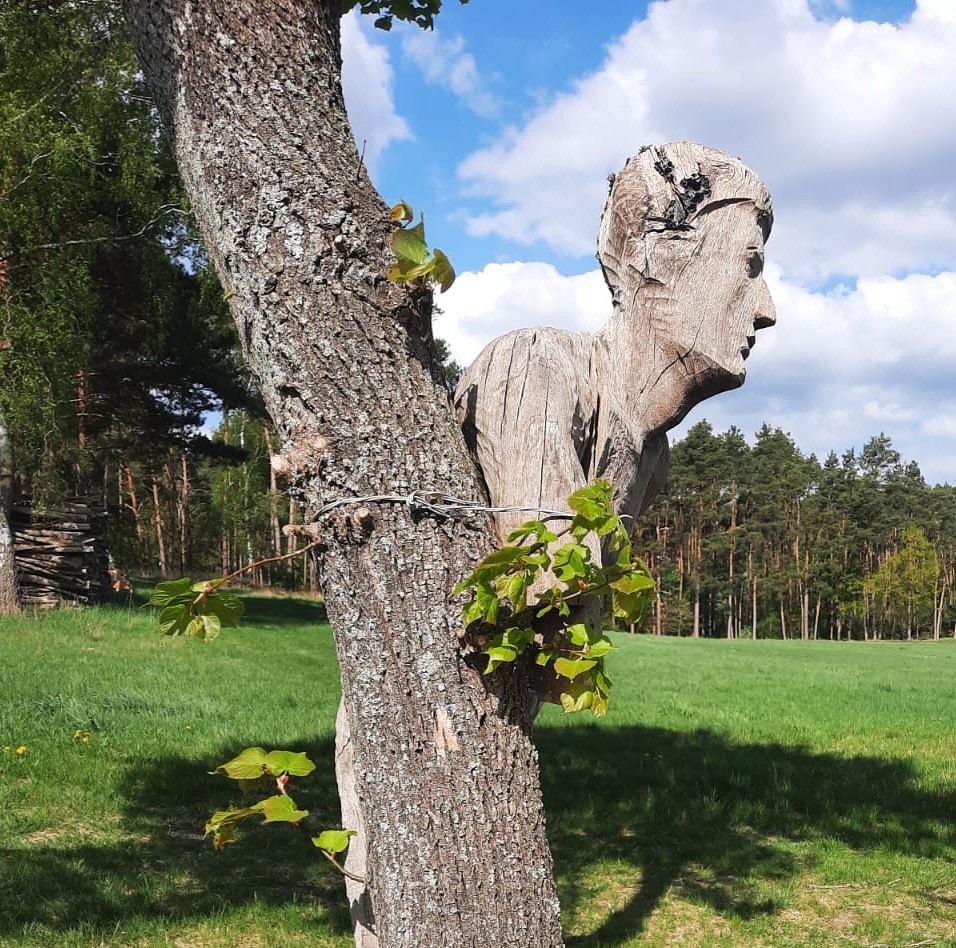
Bild: © Therese Feiler, Heide (2026).